
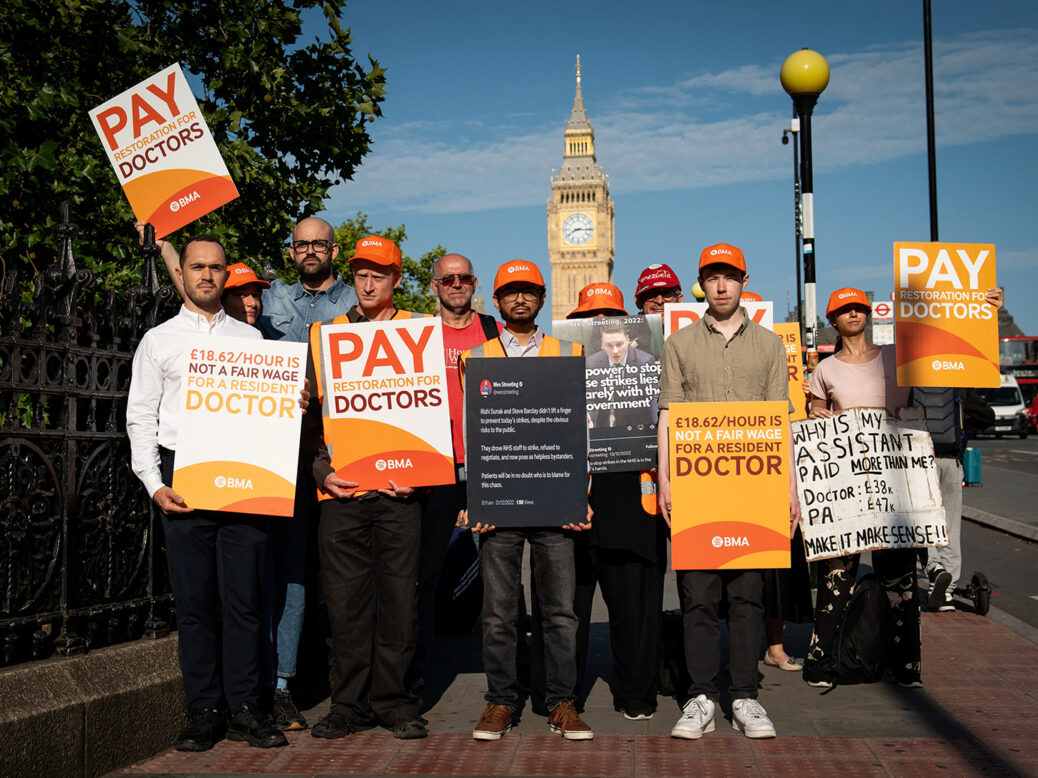
My brother phoned me last week: “Keir Starmer has threatened to axe the 1,000 extra training posts for resident doctors if they don’t call off their strike!” He sounded excitedly scandalised by this Trumpian turn of events, with Starmer effectively saying: if you don’t do what we want, we’ll hit you where it hurts. There is clearly deep frustration in government at its inability to resolve the resident doctors’ dispute.
Labour inherited a triple mess from the Tories. Resident doctors’ real-terms salaries were cut further than virtually any other workforce during austerity. A failure to expand postgraduate training capacity to accommodate the increased numbers graduating from medical school, coupled with visa changes that opened the NHS up to huge numbers of doctors from abroad, left a generation of UK-trained medics with blighted career prospects or unemployment. And the botched introduction of physician associates (PAs) – a new NHS role requiring only a fraction of the training that doctors undergo and who earn substantially higher salaries than many residents – only compounded the demoralisation in the ranks.
The Health Secretary, Wes Streeting, has been trying to address the issues. Substantial pay rises for residents have eased some, though not all, of the tension. Those additional postgraduate training places – the subject of Starmer’s threat – together with the recent Medical Training (Prioritisation) Act, which ensures UK-trained medics are preferred for training jobs over doctors from abroad, should start to improve career prospects. And while physician associate salaries remain anomalous, the Leng Review, commissioned by Streeting and published last summer, appeared to have gone some way to scotching the practice of replacing resident doctors with PAs.
The latest breakdown in talks, however, illustrates the fundamental gulf. The government argues that, fiscally constrained as it undoubtedly is, it has been as generous as it can be; resident doctors should be grateful for what they’ve got. That line is certainly finding sympathy with some members of a public weary of yet more industrial action. But I don’t believe resident doctors will – or should – back down.

The medical profession at large feels its values and very existence have been progressively degraded over the past 15 years. The PA scandal is just the most visible evidence of a prevailing belief in policy circles that much of what expensively trained doctors do can be delivered by lesser qualified and cheaper staff. The resident doctors’ goal of full-pay restoration has become totemic of a battle to preserve the profession. There is self-interest in that, of course. But there is also a genuine belief that patients deserve the quality of care that only rigorous medical training can deliver. I suspect that the British Medical Association – in common with many in the wider profession – believes we are at a point of no return. Achieve the totem of pay restoration and there is a chance of preserving medicine. Blink or lose heart and all we will see is inexorable decline and degradation.
Talks might yet resume, and by the time this column appears in print the industrial action might have been averted. But one thing I am sure about: if the strike is called off, it won’t be because of Starmer’s threat. If I must make a prediction, I suspect it will be ongoing: another clash that is presented in the media in terms of what doctors take home but is about something more fundamental.
I’m sure Streeting understands the true nature of the battle lines. In the background, the General Medical Council is consulting on plans, driven by the Department of Health and Social Care, to open its specialist register to non-doctors. At some future point, the “cardiologist” or “oncologist” or “surgeon” you see – to say nothing of your “GP” – might not have undergone medical training. Those running the NHS think that will be OK. Most members of the medical profession emphatically disagree.
[Further reading: Trump’s dead-end war]
Content from our partners



Related



This article appears in the 08 Apr 2026 issue of the New Statesman, The Fall
Join the debate
Subscribe here to commentWith the rising cost of healthcare and an ageing population, it’s naive to think that policy makers should not consider how to make a service more productive, where 70% of costs are workforce. As the most influential profession of course that includes doctors. The smart ones will engage in the debate rather than complain.
Resident doctors new pay claims? Greedy is the word that comes to mind.